 Classic
This is more of a correctness, stability and performance improvement release. New features: GraphLake and improved support for SQL pushdown, external catalogs and lakehouse table formats.
Storage, WAL, checkpoints, indexes
A failed/partial checkpoint no longer leaves the disk in a corrupted state where it can’t be recovered. Hash PK corruption is handled via a runtime exception rather than a compile-time DASSERT, which is compiled out in release builds.
Correctness
We now pass TSAN and UBSAN. While this doesn’t prove that we don’t have concurrency bugs, it improves the confidence in the quality of the code.
Many improvements fix problems where previous releases silently returned wrong results.
Planner and optimizer
Support for more query patterns that are now handled with optimized physical operators instead of materializing millions of rows. Net result: a leadership position across unofficial LDBC SNB benchmarks: the 14 complex queries and 30 Prashanth Rao queries. Much improved results on LSQB as well.
External Catalogs and SQL Pushdown
We now support scanning a SQL catalog by convention. As long as the tables and columns are named a certain way, you can start querying tables by simply attaching and using Cypher. The queries are auto-translated to SQL and executed efficiently by the underlying planner. More query patterns including recursive CTEs are supported.
When you do export database '/path/to/backup', we now use the icedisk format for export. This format can be queried via a duckdb extension or the exported data can be moved to object storage and queried remotely using hf://.. or xet://... URLs.
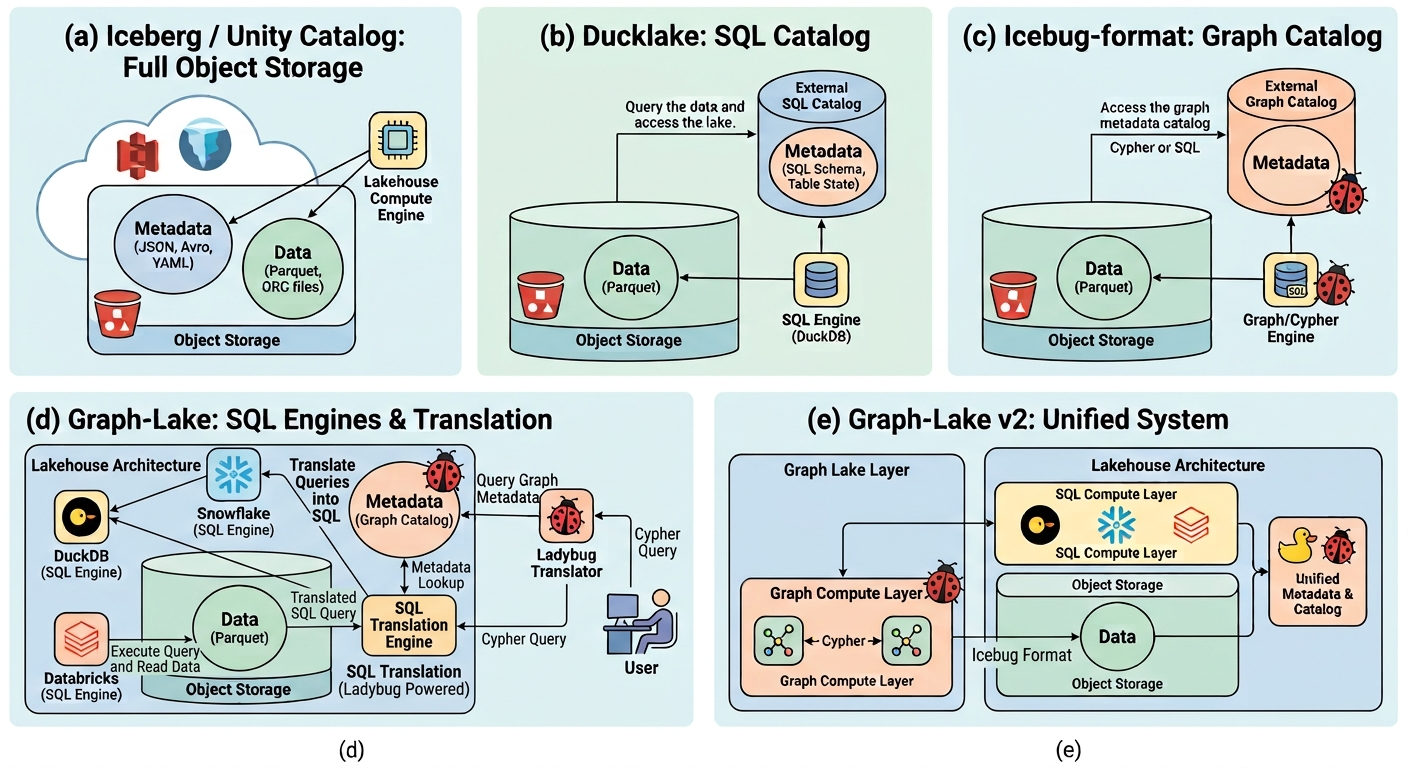
We are inspired by the idea of using the catalog of a SQL or Cypher database instead of JSON files on object storage. This is the basis of GraphLake (Iceberg tables + Icebug-Disk). It’s only fitting to add support for DuckLake via a new ducklake extension module.
ATTACH 'users.ducklake' as dl (dbtype ducklake);
MATCH (a:dl.person)-[b:knows_rel]->(c:dl.person) RETURN count(*);
Improved documentation on how to use Ladybug with Iceberg tables and on vendor clouds such as Snowflake and Databricks (coming soon!).
Postgres Integration
Postgres is everyone’s favorite OLTP database. The Postgres core team has chosen to defer the implementation of PGQ (a graph query language) to the next release, which is likely a year away. In the meantime, you can continue to use the pg_ladybug extension.
The pg_ladybug approach is similar to pg_duckdb in that it brings in columnar storage which is much faster than running PGQ over heap storage. Unlike pg_duckdb, pg_ladybug also supports local NVMe storage in addition to object storage.
GraphLake Vision
To understand how all these pieces fit together, we put together this explainer.
- How Iceberg works today
- DuckLake design (supported in 0.21.x)
- Icebug Disk design (very similar to DuckLake. Replace SQL with Cypher)
- Where we are today
- Where we want to go